
Muscle Soreness
Almost everyone who’s tried a new type of training has experienced it: you feel fine the day of the workout, and then wake up the next morning barely able to walk down the stairs. This delayed soreness has a name — delayed onset muscle soreness, or DOMS — and while it’s extremely common, it’s often misunderstood, in both directions.
What’s actually happening
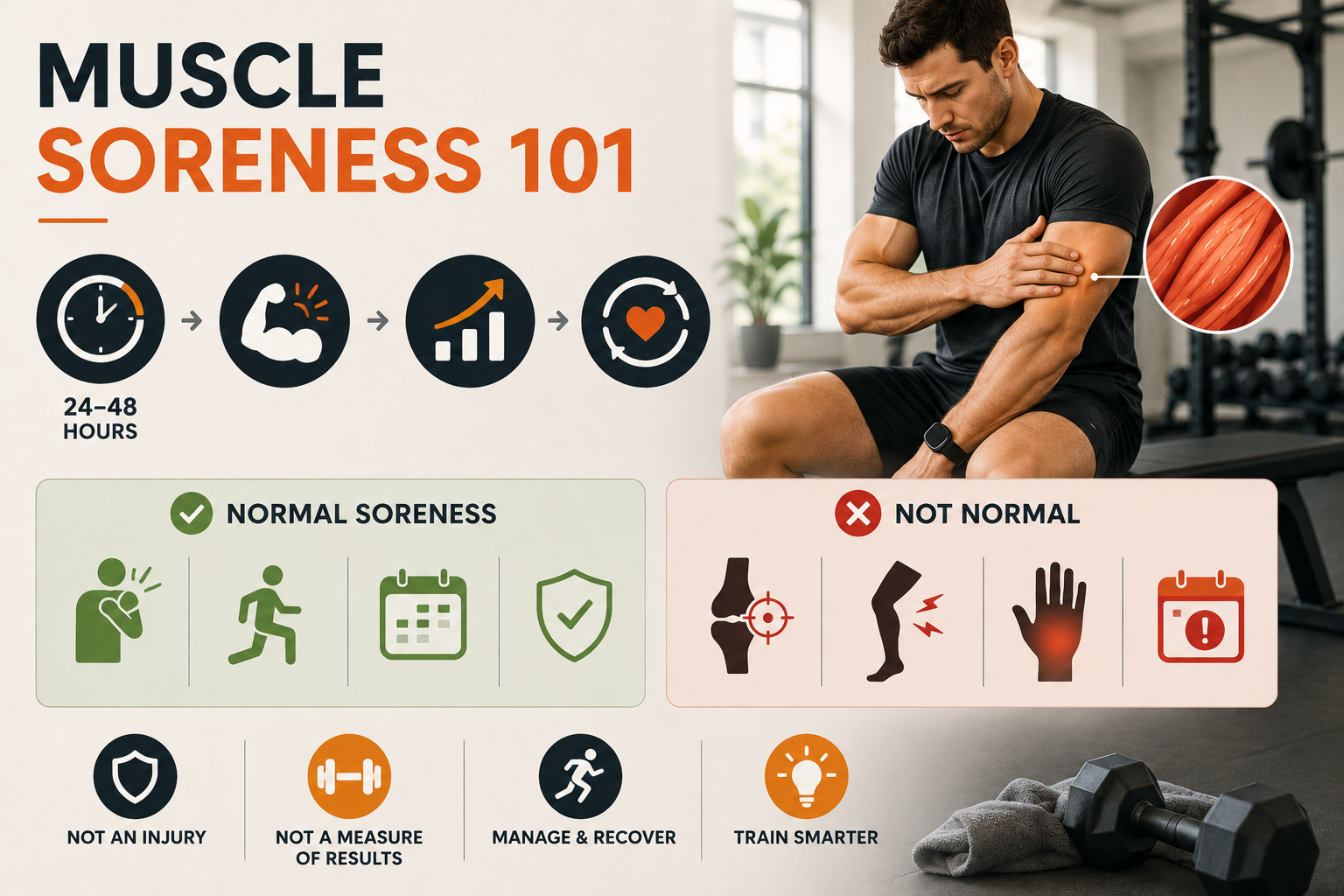
DOMS typically shows up 24 to 48 hours after a workout, particularly one that included unfamiliar movements, a new range of motion, or more eccentric loading (the lengthening phase of a movement, like lowering into a squat) than your body is used to. The current understanding is that this involves small amounts of microscopic damage to muscle fibres and the resulting inflammatory response as the body repairs and, over time, strengthens that tissue.
Importantly, DOMS is not the same thing as an injury, and it isn’t actually a reliable measure of how effective your workout was. A lot of people equate soreness with progress — “if I’m not sore, it didn’t work” — but that’s a myth. You can make excellent progress from a session that leaves you barely sore at all, especially once your body has adapted to a particular type of training.
What normal soreness feels like
Typical DOMS presents as a dull, generalised ache or tightness in the muscles that were trained. It’s usually most noticeable with movement or when the muscle is stretched, tends to peak around the second day, and gradually fades over one to three days. It doesn’t usually affect a specific joint, and it doesn’t come with sharp or localised pain.
When soreness is telling you something different
There’s a distinct category of discomfort that isn’t normal DOMS and is worth paying attention to:
Sharp, localised pain in a joint rather than a muscle. Pain that appears during the movement itself rather than the following day. Noticeable swelling, bruising, or a joint that feels unstable. Soreness that hasn’t improved at all after a week, or that gets worse rather than better.
Any of these are reasons to stop, rest, and — if it doesn’t resolve — get it checked by a medical professional rather than pushing through. This is also part of why working with a trainer matters in the early stages of a new programme: knowing the difference between “this is a normal adaptation” and “this needs attention” isn’t always obvious from the inside, and a second set of eyes on your form can prevent a lot of these situations from happening in the first place.
Some soreness is a normal, expected part of training something new. It’s not something to chase, and it’s definitely not something to fear — it’s just useful to understand what it actually means.
Leave a Reply